
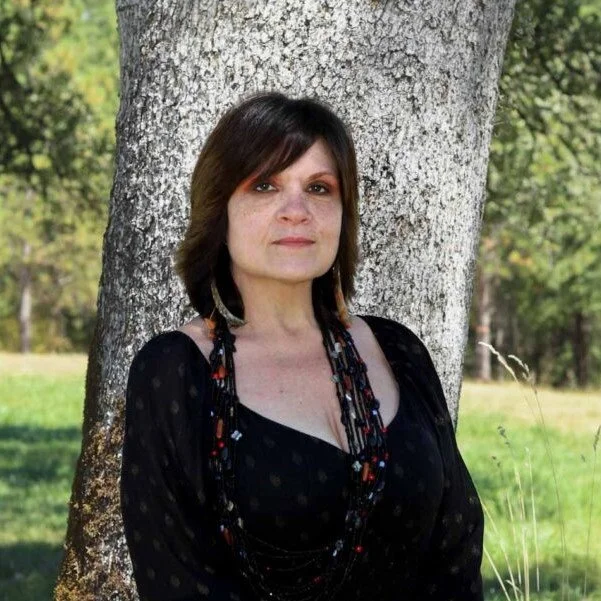
Shelly Covert
Nevada City Rancheria Nisenan Tribal Spokesperson
Executive Director, HUŚWEJ
Around Nevada City, bare mountainsides and deep fractures in the earth are now typical features of the landscape. To Nisenan Ancestors, who were the original stewards of this region, the mine-scarred lands would be unrecognizable. Except, perhaps, for 417 undisturbed acres nestled in the Sierra Nevada foothills, which provide a glimpse of what Nisenan Homelands once were. Today, the property is being returned to Nisenan descendants, the Nevada City Rancheria Nisenan Tribe, representing another milestone in the Tribe’s journey to reclaim their story.
The driving force behind the recent land acquisition is Shelly Covert, Nisenan Tribal member and Spokesperson and Executive Director of the Tribally guided 501c3, HUŚWEJ (formerly the California Heritage: Indigenous Research Project). Through her different roles, Shelly works to preserve Nisenan Culture by teaching others about the Tribe’s history and supporting Nisenan members in their generational healing. The Nisenan history that Shelly is committed to bringing awareness to is one from the perspective of her Ancestors, which is often missing from history lessons. In the mid-1800s, the Nisenan people were forcibly removed from their Homelands by settlers in pursuit of gold. This loss of family and connection to the land was the start of a systematic erasure of Nisenan language, Culture, and identity. Eventually, reparation was delivered to some Tribes in the form of sovereign governance on reserved land.
For the Nisenan Tribe, this period of rebuilding came to an abrupt stop when their federal recognition was stripped in 1964. Without land or federal resources, the Tribe found themselves further fractured, making it even harder for members to gather, connect, sustain cultural practices, and build economic security. Shelly explains that these threats to Nisenan survival are still experienced by its members today, and HUŚWEJ is at the forefront of her plan to change that.
To help her Tribe reconnect with their heritage, Shelly and HUŚWEJ provide opportunities for members to access their Ancestral Homelands. Most recently, HUŚWEJ gained valuable experience on how to purchase land for the Tribe through the Sustainable Agricultural Lands Conservation Program’s (SALC) Planning and Capacity Building Grants pathway. Shelly, was able to build knowledge and gain experience of the complicated world of land agreements through the program and HUŚWEJ’s SALC partner, the Bear Yuba Land Trust. With newly acquired confidence and a SALC Acquisition Grant, Shelly set off to find land to purchase that reflected the Nisenan Tribe’s vision and needs, which was not a simple task. That’s why it felt like magic to Shelly when a non-mined parcel of their Homelands was listed on the market.
“It’s like somehow, somebody just turned time off in that little bubble and it was waiting for us. Waiting for all these people to come together so that they could press play on that bubble again.”
On the property, the stream runs strong and clear and Nisenan petroglyphs still blanket the scattered boulders. The Tribe’s Ancestors walked these lands, and drank from these waters, and now their living Tribal family can do the same, writing their own Nisenan story along the way. Shelly recognizes that the journey to this point did not start with her own, but with those of her Ancestors and Tribal advocates that came before her.
“There are some amazing female California Native leaders that are working every day to raise visibility of the story of genocide here. I put these people on such high ground because I know how hard the work is. It’s all collectively taken a long time to build, in a million different places and moments. It’s taken generations of people telling their story and it’s taken generations of people standing with us in our Homelands as people today and hearing us.”
-
HUŚWEJ received funding through the Sustainable Agricultural Lands Conservation program’s Planning and Capacity Building Grants and Acquisition Grants.