Programs for Tribal Governments
Tribal governments can receive funds to reduce climate pollution through clean transportation, agricultural equipment, clean air initiatives, land conservation projects, and more. Learn about open funding opportunities, resources to help you learn more about California Climate Investments and how to apply for funds, and read stories of funded projects led by tribal governments.
Funding Opportunities for Tribal Governments
The programs listed below have funding available now or will offer funding in the near future. You can save or print the list of programs with funding available now using the buttons below.
We encourage you to also view all programs available to tribal governments, including both open and closed programs. Learning about programs early can help with planning for future funding rounds.
Funds conservation and management of natural and working lands and technical assistance for land managers.
Funds project that advance ocean and coastal resilience and adaptation, consistent with the 2020-2025 Ocean Protection Council Strategic Plan.
Funds planning and implementation projects that reduce the impacts of extreme heat and increase community resilience.
Funds placement of full-time service members with public agency, nonprofit, tribal, and educational institution partners to support community engagement efforts.
Technical assistance for small, disadvantaged communities to address drinking water, wastewater, stormwater, or groundwater needs.
Grants that support the development of sea level rise adaptation plans and projects to build resilience with a dedicated funding pathway for Tribes to assess and plan for impacts on cultural resources.
Financial incentives for planning, purchase, and installation of publicly available charging equipment.
Financial incentives for EV charging stations with priority for shovel-ready projects in disadvantaged and low-income communities.
Grants for land use planning, capacity building, and land acquisition projects that protect agricultural land from conversion to non-agricultural uses.
Grant application assistance and implementation support for Tribal, disadvantaged, and low-income communities applying for or carrying out climate mitigation, adaptation, or resilience projects.
Vouchers for clean truck and bus fleet purchases for public transit and innovative small e-fleets.
Grants that support mobile source air pollution reduction measures for communities identified through the AB 617 Community Emissions Reduction Programs.
Funds development of a Forest Management Plan and Registered Professional Forester supervision of reforestation, stand improvement, conservation, and habitat improvement activities.
Funds coverage of losses resulting from a prescribed or cultural burn that escaped control.
Grants that support wood product and bioenergy projects and workforce development in the forestry sector.
Funds water system consolidation, operation and maintenance costs, and planning activities for small water systems.
Resources for Tribal Governments
NEW: The California Environmental Protection Agency has included federally recognized Tribes in its recent designation of disadvantaged communities.
For the purposes of this designation, a Tribe may establish that a particular area of land is under its control even if not represented as such on CalEPA’s disadvantaged communities map and therefore should be considered a disadvantaged community by requesting a consultation with the CalEPA Deputy Secretary for Environmental Justice, Tribal Affairs and Border Relations at TribalAffairs@calepa.ca.gov.
California Air Resources Board
Collection of resources for California Climate Investments administering agencies, prospective applicants, grantees, and public audiences.
California Air Resources Board
Calendar containing upcoming California Climate Investments funding timelines, public participation opportunities such as workshops, public comment periods, listening sessions, and more.
California Air Resources Board
An interactive resource that guides Tribes through narrowing down which California Climate Investments funding opportunities might be a good fit based on your Tribe’s needs and priorities.
California Air Resources Board
Community Connections is a tool to help organizations and agencies find partners interested in California Climate Investments. Partnerships ensure that project proposals reflect the perspectives needed to build resilient communities and implement meaningful investment.
California Strategic Growth Council
The Hub is designed to enable practitioners, policymakers, and communities at any point in their racial equity journey to increase access and understanding to relevant resources and best practices.
California Air Resources Board
California Climate Investments light duty, heavy duty, and clean mobility project snapshots and lessons learned.
California Air Resources Board
Example guidance from the Sustainable Transportation Equity Project (STEP) where applicants are encouraged to consider how projects can increase adaptability and build resilience to the specific impacts of climate change on the STEP Community over each project’s lifetime.
Industrial Economics, Inc.
An analysis and evaluation of ecosystem service benefits California Climate Investments projects provide by funding nature-based climate solutions. The resulting report explores how carbon mitigation projects can generate ecological and environmental improvements that enhance the health, wealth, and well-being of California residents.
Investments in Action: Projects Funding Tribal Governments
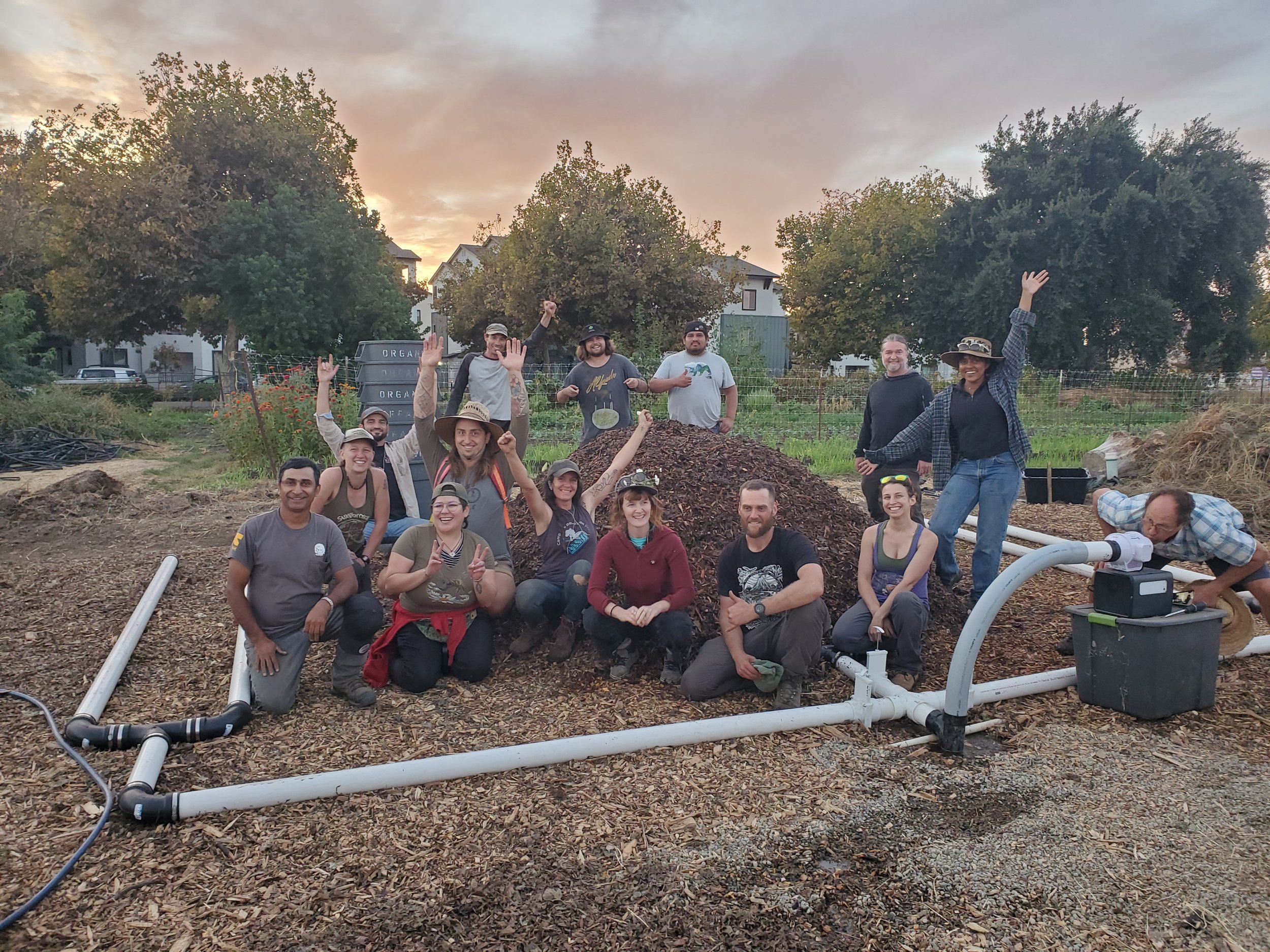
California Department of Resources Recycling and Recovery’s (CalRecycle) Community Composting for Green Spaces Grant Program is funding community composting at hundreds of sites across California. In the first cycle of funding, the grant program awarded $1.5 million to the People, Food, and Land Foundation, which supported community composting at 117 sites throughout California, planted 488 trees, created 4,418 cubic yards of compost, and reduced emissions by 2,508 MTCO2e of GHG emissions. An additional $4.2 million was awarded to the California Alliance for Community Composting and LA Compost in the second cycle of the program. Through the establishment or expansion of community composting sites, communities receive benefits such as part time jobs and training on composting practices, fresh produce from adjacent gardens, training on farming practices, an increase in shade from tree planting, and the development of green spaces.
In 2020, Sarah Light, agronomy advisor at the University of California Cooperative Extension, partnered with the Colusa County Resource Conservation District, Davis Ranch, Richter Ag, and the United States Department of Agriculture Natural Resource Conservation Service to apply for a CDFA Healthy Soils Program Demonstration Grant. The team received $99,832 of grant funding to conduct a demonstration project on cover crops on two fields in the Sacramento Valley from fall 2020 to spring 2024.
In the Hoopa Valley Tribe’s homelands, California Climate Investments funding is helping the Hoopa Valley Tribe re‑introduce fire to an important oak woodland ecosystem. The work is supported by a $1.36 million grant from CAL FIRE’s Forest Health Program. The eastern side of the Hoopa Valley, on the current Hoopa Valley Reservation in what is known today as Humboldt County, has historically been home to extensive oak woodlands. Fire has always played an important role on this landscape—the people burned the hillsides for generations to maintain the oak trees and promote growth of other culturally important plants.
California Department of Forestry and Fire Protection
A $4.3 million grant from CAL FIRE’s Forest Health Program to the Humboldt County Resource Conservation District is funding work to protect natural, cultural, and spiritual values in a key watershed in the Yurok Tribe’s ancestral homeland.
California Department of Forestry and Fire Protection
A $5 million CAL FIRE Forest Health Program grant is supporting the Western Klamath Restoration Partnership in their efforts to restore fire resilience at the landscape scale along the Klamath River. This project is part of a larger effort by the Western Klamath Restoration Partnership to improve forest health and resilience across a 1.2 million acre planning area that includes much of the Karuk Tribe’s ancestral homelands.
With a $990,350 award from the Climate Change Research Program, the Resilient Restoration project – led by the Climate Science Alliance Tribal Working Group, University of California Riverside, and San Diego State University – is promoting Tribal resilience by developing knowledge and supporting actions that enhance persistence of cultural practices with a focus on preserving the ecosystems and species that are integral to Tribal communities.
Using funds awarded by the Clean Mobility Options program, the Big Pine Paiute Tribe of the Owens Valley, a federally recognized California Native American Tribe, conducted a community-driven transportation needs assessment to determine the transportation needs and preferences of Big Pine Paiute’s residents. After the needs assessment is completed and approved by their Tribal Council, the Big Pine Paiute Tribe can use it to apply for additional funding from Clean Mobility Options or other transportation grant programs to implement clean mobility projects.
The Pauma Band of Luiseño Indians are scaling up their carbon farming operations on Pauma Tribal Farms. This project includes funding for on-farm practices such as cropping, compost application, hedgerow installation, no-till, and a transition from row crops to trees for 35 acres of farmland.
With the help of technical assistance providers funded by the California Strategic Growth Council’s California Climate Investments Technical Assistance program, Arcata 30th Street Commons became the first tribal led project funded by California Climate Investments through the Affordable Housing and Sustainable Communities program. The project, proposed by the Yurok Indian Housing Authority, earned a $11.4 million award and exemplifies how a strong vision, combined with partnership, technical assistance, and investment can help transform an under resourced community.
The North Coast Resource Partnership is a unique coalition of North Coast Tribes and seven counties that represent the North Coast and Klamath/Interior Coast Ranges ecological regions, both of which are important carbon storage areas in California. To help protect the health of forests in this territory, the North Coast Resource Partnership is using $4,037,500 of California Climate Investments funding through the Regional Forest and Fire Capacity Program to develop a regional priority plan that will generate implementation‑ready projects and provide funding for demonstration projects.
The Tribal air monitoring project aims to measure pollutants continuously and share that data with Tribal members and the community to raise awareness about the potential issues caused by the Salton Sea and other sources of emissions in the area.
STAY UP TO DATE. Sign up for the California Climate Investments newsletter to receive program updates, news, events and more.